Howard is a Partner and the Director of Municipal Bond Research for Evercore Wealth Management. He has over 30 years of experience in analyzing municipal securities.
Prior to joining Evercore in 2009, Howard was a director at the Public Finance Department of Financial Guaranty Insurance Company for 11 years. He previously was a vice president with the investment banking firm of Prager, Sealy & Co. and, earlier, a vice president at Moody’s Investors Service. He began his career as an economist with the New York State Senate Finance Committee in Albany, New York.
Howard is widely quoted in the media, including The Wall Street Journal, Bloomberg News/Business Week, Barron’s, Reuters, The Financial Times and The Bond Buyer, and he has appeared on CNBC, National Public Radio and Bloomberg News.
Howard received a Bachelor’s Degree in Economics from the State University of New York at Albany, and a joint Master’s Degree in Public Affairs from the Lyndon B. Johnson School of Public Affairs and an M.B.A. from the McCombs School of Business.
Editor’s note: This article is extracted from a recently published paper. Click here to read the paper in full.
There are as many opinions about the future of New York City as there are New Yorkers. The city, which was the early U.S. epicenter of the pandemic, is now the focus of discussions around the future of urban life.
Some have voted with their feet; others are certain that the city’s best days are ahead. From a fiscal point of view, the future of the largest municipality in the United States matters to investors well beyond the five boroughs. The key will be to distinguish between short-term disruptions and lasting change.
While full out-migration patterns to date are in line with previous moves, there is still potential for a permanent – and negative – shift. The trend to remote work has coincided with improved communications technology and a significant demographic shift as two giant population groups, Millennials and older Baby Boomers, transition to family and retirement life, respectively, and from the costs and other stressors of high-density living.
In addition to migration out of the city, and the considerable related existing and potential revenue implications, the city’s fiscal health will represent a big challenge for the next mayor (who will be elected in November). So too will public safety and the new awareness in all quarters of the city of the need for a more inclusive and equitable economic recovery. It is our view that New York City will remain a global center for finance, education, healthcare, technology and culture, but not without changes to its prior established position. Investment exposures should be allocated and managed accordingly.
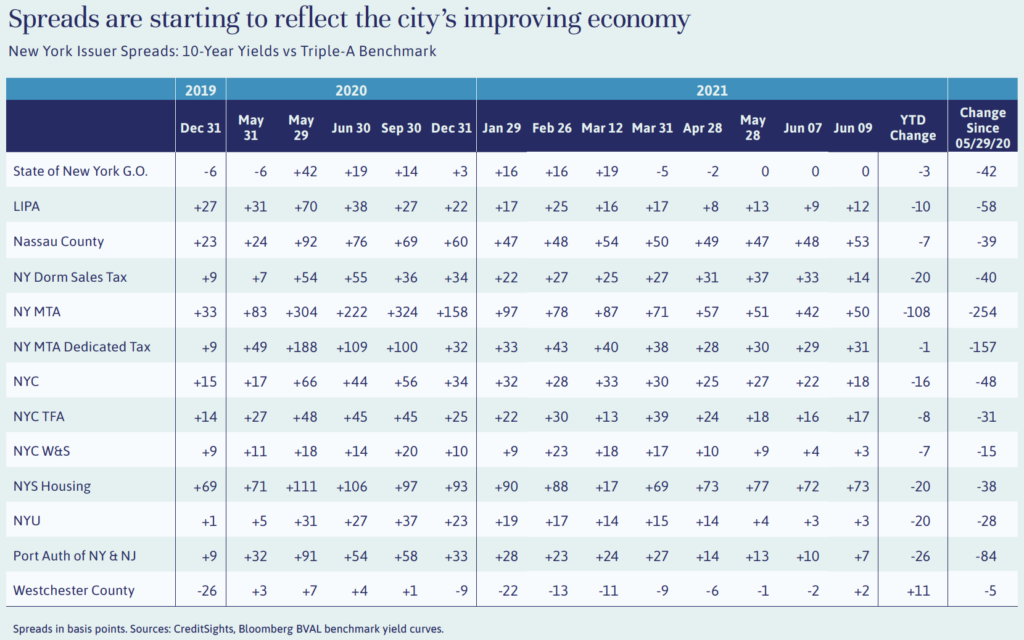
Spreads, or the difference in bond yield between the issued debt and gilt-edged AAA-rated debt, are starting to reflect the city’s improving economy, thanks to the implementation of federal programs and effective vaccine distribution (see the chart below). Still, most spreads are wider now than pre-pandemic levels at the end of 2019, which means there are still selective buying opportunities, assuming the economy continues to recover. We will continue to monitor the pace of the economic recovery and the spreads on these New York credits to determine buying opportunities.
Howard Cure is a Partner and the Director of Municipal Bond Research at Evercore Wealth Management. He can be contacted at [email protected].
This Independent Thinking® issue explores the challenges and opportunities of managing investment portfolios amid buoyant but increasingly volatile markets. It discusses the risks of market peaks, the potential for inflation