
We’ve just experienced the best quarterly equity market returns since the beginning of the Covid market recovery back in 2020. The S&P 500 total return was up 15.2% for the three months, the Nasdaq Composite and Russell 2000 (small cap) Index were both up 21.6%, and the MSCI ACWI ex-US was up 14.7%. While investors are right to wonder how much gas the market has left in the tank, it’s important to note that these gains have been driven by rising earnings estimates, not by rising valuations.
DATA CENTERS AND ARTIFICIAL INTELLIGENCE
In our view, the AI investment cycle does not currently look like a classic bubble. While AI capex among hyperscalers in 2026 is estimated at roughly $850 billion – up sixfold in three years, with spending growth expected to continue – the companies making the largest investments have strong balance sheets and massive operating cash flows.1 Are they overspending? Maybe. Shares in the Mag 7 lagged for the quarter, while the companies benefiting from all that spending – semiconductors and other hardware producers, data center construction, power generation, cooling systems, and others – drove much of the market returns and earnings growth.
Some of the spending may ultimately prove too aggressive. Supply and demand imbalances related to infrastructure, e.g. not enough chip or power generation, will either limit AI growth or continue to cause cost inflation for the spenders, a subject we will examine in depth in the next issue of Independent Thinking. At present, however, the current supply has been met with more than ample demand and uptake for the technology has broadened throughout both the consumer and corporate sectors.
INFLATION, GEOPOLITICS, AND THE FED
The risk of sustained energy price increases feeding through to global inflation seems to have mitigated with the gradual reopening of the Strait of Hormuz. We aren’t ruling out further shocks, but it is clearer now that China’s massive oil reserves, combined with the country’s structural shift to renewable power generation, mitigate exposure. And, of course, the United States is largely energy independent.
Still, inflation in the United States remains well above the Federal Reserve’s 2% target rate, with both common measures of broad inflation (CPI and PCE) over 4% year-over-year in May. Along with the lingering energy spikes, hardware costs due to the AI boom and sticky inflation in the services sector are to blame. Meanwhile, consumers are still spending, incomes are still growing, and employment markets remain on solid ground. In our view, the new Fed Chair, Kevin Warsh, may hold off on cutting rates and consider raising them later this year.
EARNINGS, NOT JUST VALUATION
Valuations aren’t cheap, at 20.1x for the S&P 500 forward P/E ratio. But they aren’t all that expensive either. Expected earnings growth over the next 12 months grew over 18% from the start of the year (see chart on the following page) as of June 30, and while the S&P 500 price is up around 10%, the P/E ratio has been driven lower, from 22.8x, where it stood at the beginning of the year, to 20.8x. It is unusual for earnings estimates to expand to this degree, except during a recovery. While AI has been the dominant factor, earnings growth has been broadening to sectors beyond technology, to energy, materials and industrials. If earnings breadth continues to improve, the market can remain resilient even if share valuations in individual AI leaders experience corrections. But profit margins are historically high, which will require earnings growth to remain robust to maintain those record margins. Again, the market is being driven by earnings estimates, not valuations and could have room to continue higher as robust earnings growth continues to persist.
S&P 500 INDEX, INDEX = 100 ON 12/31/2025
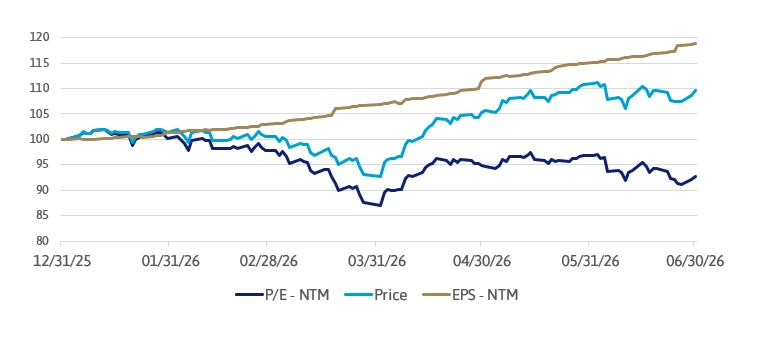
Source: FactSet
We assess our views by the asset classes below:
CASH AND DEFENSIVE ASSETS
With the Federal Reserve Fed Funds Rates target set at between 3.5% to 3.75% and the Fed contemplating interest rate hikes, not cuts, over the balance of 2026, cash remains a useful asset class, not just a placeholder. Intermediate and long-term fixed income remain stable, with modestly positive total returns for both the quarter and year to date, across Treasury, corporate and municipal bonds. In the municipal bond market, record levels of supply have been met with robust demand, leaving market prices relatively stable.
CREDIT STRATEGIES
Credit spreads (the difference between risk-free Treasury yields and the yields of riskier bonds, currently at ~2.6%), remain relatively low compared with long-term averages. But corporate fundamentals are still supported by earnings growth, strong margins, and manageable default rates.
We continue to seek diversified investment risk by taking credit risk more than interest-rate risk and we still favor selected high yield corporate exposure and pools of consumer loans and commercial and residential mortgages where underwriting is strong, and pricing is attractive. Business Development Corporations, or BDCs (publicly traded vehicles that own a portfolio of middle market, floating-rate, corporate loans), generally trade today at a discount to net asset value, and we view these as particularly appealing at present.
Our view remains that the risks around private credit are manageable rather than systemic. The improvement in corporate earnings expectations is also supportive for credit. If corporate profits continue to rise, weaker borrowers have more room to refinance and service debt. Tight spreads leave less margin of safety, however. Manager selection and security selection remain important, particularly in lower-rated credit and private lending.
DIVERSIFIED MARKET STRATEGIES
Our Diversified Market Strategies asset class is intended to provide a return stream with low correlation to both equity and bond markets and to maintain a positive real expected return through a full market cycle. The case for diversification has not changed. Geopolitical risk is lower than it was at the peak of the Middle East conflict, but it has not disappeared. Government debt levels remain high, fiscal deficits are still large, and the competition between the United States and China, especially around AI, semiconductors, and strategic infrastructure, continues to shape the long-term investment environment.
We continue to believe that a modest gold allocation has a role in balanced portfolios. The decline over the course of the Iran war can be attributed to profit-taking post record highs, and it has historically been viewed as a potential safe-haven asset. For clients with the right risk profile, a small allocation to Bitcoin can also be considered as a store of value or asymmetric-risk asset. The easing of the oil shock makes broad commodity exposure less urgent than during the last quarter, but real assets can still provide useful diversification against renewed inflation or geopolitical stress.
GROWTH ASSETS
We continue to favor equities over the long term, while recognizing that valuations remain above historical averages. We also continue to favor the United States, with emphasis on companies with durable competitive advantages, strong balance sheets, and clear paths to benefit from AI-driven productivity or infrastructure spending. At the same time, we continue to recommend increasing exposure to international markets. International equities still trade at valuation discounts to the United States and overall earnings growth outside the United States has improved. A mix of active and passive investments remains prudent.
While the overall market is at least reasonably valued, there are pockets of excessive valuation and pockets of higher leverage – record margin debt and record assets in leveraged ETFs. But as we see it, the main risk for equities is not a near-term recession; it is investor disappointment. If profits generated from the AI infrastructure buildout lag the capital spent on the buildout, if corporate profit margins retreat from their record high levels, or if inflation leads the Fed to hike interest rates further than expected, markets could reprice quickly. At present, however, the earnings backdrop is stronger than it was last quarter and continues to show not only resilience but acceleration.
PRIVATE MARKETS
Private markets remain an important source of enhanced growth, diversification, and income relative to public markets.
While outflows continued from semi-liquid credit funds, the underlying fundamentals remained relatively strong, default rates remain idiosyncratic, not systematic, and revenue and earnings growth continue, both broadly across loan portfolios and specifically within the software sector of the large, high-quality underwriters.
Private equity has avoided some of the more visible stress seen in segments of private credit, but the same questions remain – valuation marks; software exposure; distributions and exit activity. Private equity distributions have been slow for several years, which has made fundraising more difficult, although last quarter’s SpaceX IPO and other potential mega-IPOs (OpenAI and Anthropic) are changing this dynamic. Still, years of weaker distributions have created less crowded fundraising environments, which we believe may improve entry valuations and future returns.
We continue to favor disciplined managers with demonstrated underwriting skill, operational expertise and patience.
CONCLUSION
Strong returns reinforce the need not just for portfolio diversification, but also for investor discipline. Adequate liquidity, prudent use of leverage, and the discipline to avoid chasing themes after they have already been fully priced are key. We expect continued market volatility, especially around AI spending, inflation data, energy markets and Fed policy. But the underlying strength of corporate earnings, the scale of productive investment and the improving breadth of market leadership provide a solid outlook for long-term returns.