Brian is a Partner and Portfolio Manager at Evercore Wealth Management, managing investments for families, foundations and endowments. He is the Chair of the Investment Policy Committee and co-Chair of the Asset Allocation Committee. He is co-head of the New York Office, Head of the Fixed Income Team and a member of the firm’s national Strategic Planning Committee. Brian additionally serves as Chief Investment Officer of Evercore Trust Company, N.A.
Brian joined Evercore in 2009 from AIG Investments where he co-managed over $60 billion in corporate bond portfolios. Brian earlier served as a corporate bond analyst, focused on basic industries, including paper/forest products, chemicals, and packaging companies. Prior to attending business school, Brian worked for the Milken Family Foundation.
Brian received his B.A. in History from the University of Pennsylvania and his M.B.A. in Finance from Columbia University. He holds the Chartered Financial Analyst designation and is a member of the CFA Institute.
Strategic Resources, AI, and Investment Implications
The Thucydides Trap describes the likelihood of war when a rising power threatens to displace an established power. The rivalry between Sparta and Athens resulted in the Peloponnesian War, reshaping a region. The rivalry between China and the United States is global.
Just about all the current and recent conflicts are between nations or groups economically allied with China (Russia, Hamas, Iran, Venezuela) and nations economically allied with the United States (Ukraine, Israel). It’s reminiscent of the proxy hot wars in Korea, Vietnam and Afghanistan that were waged during the Cold War between the Soviet Union and the United States. Even Greenland, a Danish territory with a population of just 56,000 people, finds itself in the news. The real battle this time has little to do with ideology: It’s for economic dominance.
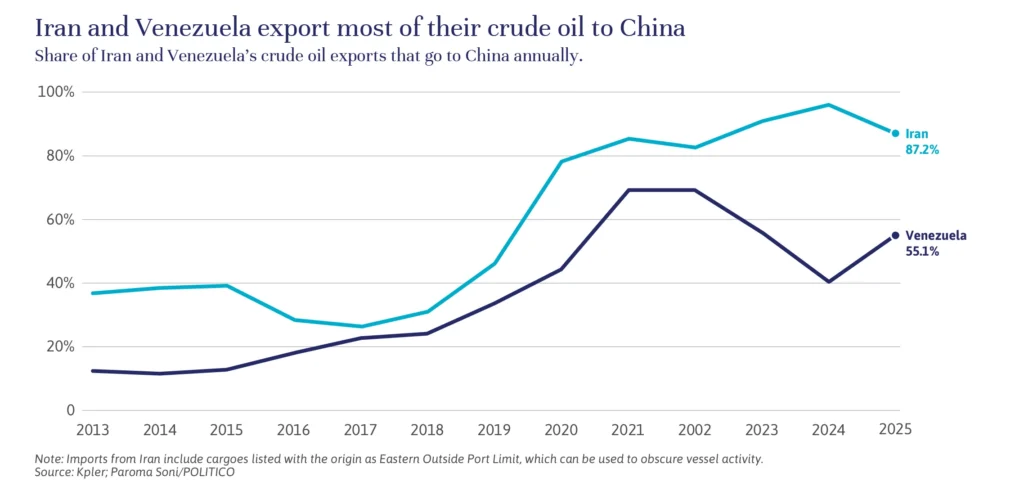
The U.S. attack on Iran in February (the second in two years) and the removal of Venezuelan dictator Nicolás Maduro in January were both strategically significant for China. Nearly 17% of China’s oil imports came from Iran and Venezuela in 2025 (see the chart on page 4). And Russia, which has become increasingly economically dependent on China since its 2022 invasion of Ukraine and the subsequent sanctions by the United States, Europe and others, has significantly increased its exports of natural gas and oil to China.
The rise of artificial intelligence, complicates matters. Indeed, it could be the single most important geopolitical factor in the coming decades, with important implications for military capability, economic productivity and cybersecurity. Both countries are making massive investments to gain an advantage. At the same time, fear of the other side winning makes them afraid to apply any brakes, despite the clear danger signals that increasingly powerful AI could present for the human labor force.
Taiwan, the largest fabricator of semiconductors used for AI – and of great strategic importance to the United States and strategic and historical importance to China – would be ground zero in this battle. Our China research colleagues at Evercore ISI maintain the view that China is not intent on taking control of Taiwan in the next decade. In any event, we believe that neither country seeks direct conflict, as the military, economic and market repercussions would be so great. In other words, we may have learned something since the Peloponnesian wars.
As we have previously discussed (see https://evercorewealthandtrust.com/globalization-reshaped/), trade and economic spheres of influence are likely to continue to evolve into a more regional form of globalization dominated by the two superpowers. While we are not suggesting that all contemporary conflicts have been executed in accordance with some grand vision, we do believe there is connective tissue between them – and it would not be surprising if additional conflicts arise between the nations and groups within the two vying spheres of influence.
Market Resilience and Long-Term Investment Strategy
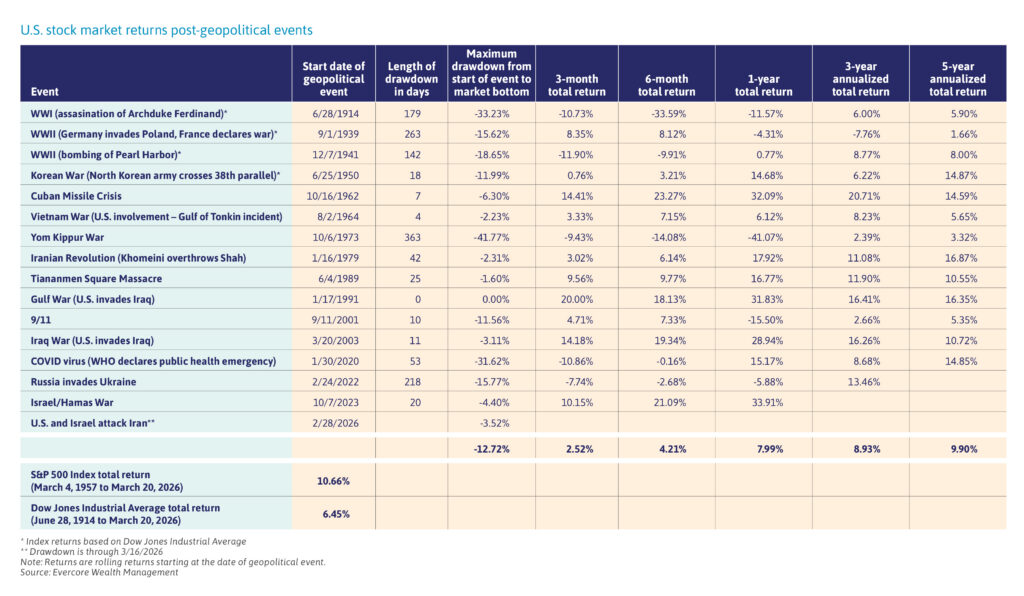
Still, it’s important to remember that while equity market drawdowns can be severe in times of geopolitical upheaval, the long-term impact is rarely negative. (See the chart below and our earlier article here https://evercorewealthandtrust.com/geopolitical-crises-and-markets/.)
For many investors, volatile markets can represent a selective buying opportunity. All investors will benefit from remaining calm and maintaining diversified and resilient portfolios, with adequate cash reserves and a disciplined approach to rebalancing.
Brian Pollak is a Partner and Portfolio Manager at Evercore Wealth Management and Chair of the Investment Policy Committee. He can be contacted at [email protected].
This Independent Thinking® issue explores the challenges and opportunities of managing investment portfolios amid buoyant but increasingly volatile markets. It discusses the risks of market peaks, the potential for inflation