Stacie is a Partner and Wealth & Fiduciary Advisor at Evercore Wealth Management and a Managing Director at Evercore Trust Company, N.A., part of the team responsible for delivering customized planning and administrative services to families, foundations and endowments. She is a member of Evercore Trust Company’s Fiduciary Oversight Group, Personal Trust Advisory Committee and the firm’s Strategic Wealth Planning Committee.
She joined Evercore in 2011 from Lowry Hill, where she worked directly with individual and family clients and was additionally responsible for operations strategies and oversight. Previously, she was a financial analyst with Norwest Bank Minnesota. She has experience in business valuations for succession planning, prospective sales and estate tax returns.
Stacie received her B.A. in Organizational Leadership at Bethel University. She completed the financial planning certificate program at Minnesota State University and holds a CFP® certification and is a Certified Trust and Fiduciary Advisor.
She is also a member of the Bethel University Business and Leadership Advisory Board.
Good wealth planning starts with conversation. Current financial circumstances, attitudes to risk and long-term goals are the obvious starting points, but the real value often shows up in the details: How comfortable are you with market concentration? How would a new business venture, a large gift or a charitable pledge affect your liquidity? What happens to your estate under current tax law – and is that still what you’d choose if you looked at it for the first time today?
Done well, regular modeling can show the long-term consequences of a range of scenarios. Monte Carlo simulations and AI-powered tools are helpful at running the plan through thousands of possible futures, including a thorough drawdown analysis, to estimate the odds of different outcomes. These capabilities can complement the judgment and experience of advisors, helping to inform thoughtful conversations and decision making.
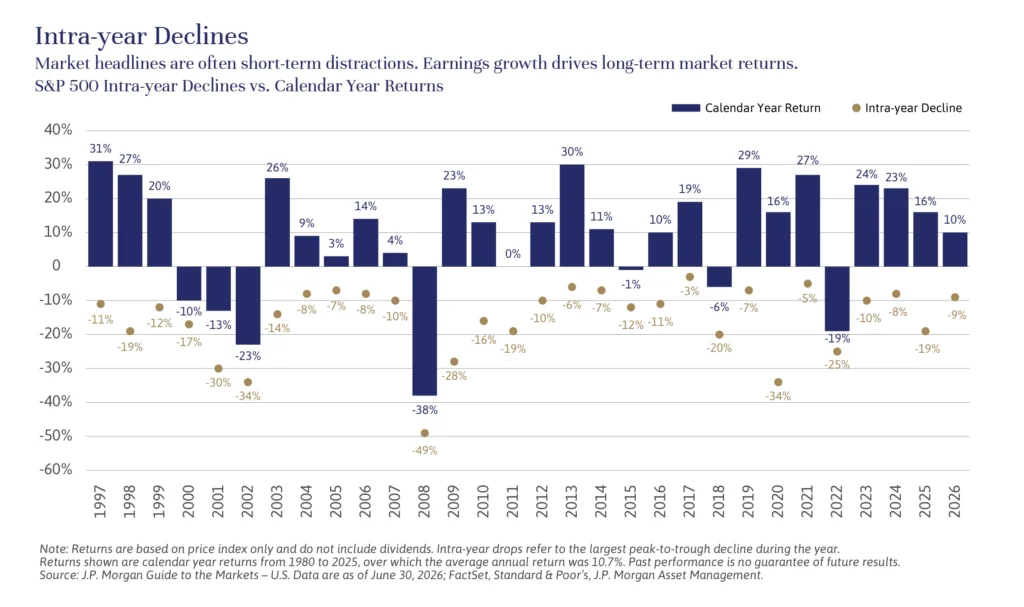
Take a look at the chart here to see what happened during recent stress scenarios, including the 2008–2009 financial crisis, the sharp 2020 COVID selloff and the brief tariff-driven shock of April 2025. While recovery from small market pullbacks takes just a month or two, it can take one to two years for a severe bear market to bottom and another couple of years for it to recover. And the market is, as we have often observed in these pages, increasingly concentrated in the technology sector, adding risk and volatility to investing as well as the opportunity for outsized returns. A plan that only gets pressure-tested once a decade isn’t built for fundamental market shifts.
Clearly, it’s important to maintain adequate liquidity to cover between three and five years of spending, depending on individual circumstances and attitudes to risk, in defensive assets, such as cash and treasuries. Liquidity reduces pressure to sell investments and trigger capital gains. For some investors, it’s worth considering a less aggressive allocation, along with the trade-offs to income and growth that decision brings.
A financial plan is only as good as its inputs and assumptions, and both have a way of going stale – sometimes because the markets change, sometimes because tax regulation does (see the article by Justin Miller on current tax law, “The ABCs of the OBBBA: Preparing for Tax Change”. And of course, life changes. Every major event – a marriage, the birth of a child, a business transition, a retirement – is reason enough to check back in with advisors and adjust course.
This Independent Thinking® issue explores the challenges and opportunities of managing investment portfolios amid buoyant but increasingly volatile markets. It discusses the risks of market peaks, the potential for inflation