Judy is a Partner and Portfolio Manager at Evercore Wealth Management in San Francisco, managing investment portfolios for families, endowments and foundations. She is a member of the firm’s External Manager Selection Committee, which is responsible for the selection, due diligence and monitoring of all third-party investment managers.
Prior to joining Evercore, Judy was a vice president at U.S. Trust, and a senior portfolio manager at Charter Financial Group, Inc. in Washington, D.C.
She received a B.A. in Economics from the University of California – Berkeley, an M.B.A. from Georgetown University’s McDonough School of Business, and holds the Chartered Financial Analyst designation. She is a member of the CFA Institute and the CFA Society of San Francisco, and also serves on the Board of Trustees of Santa Catalina School.
Too Much of a Good Thing in America? The Case for Going Global
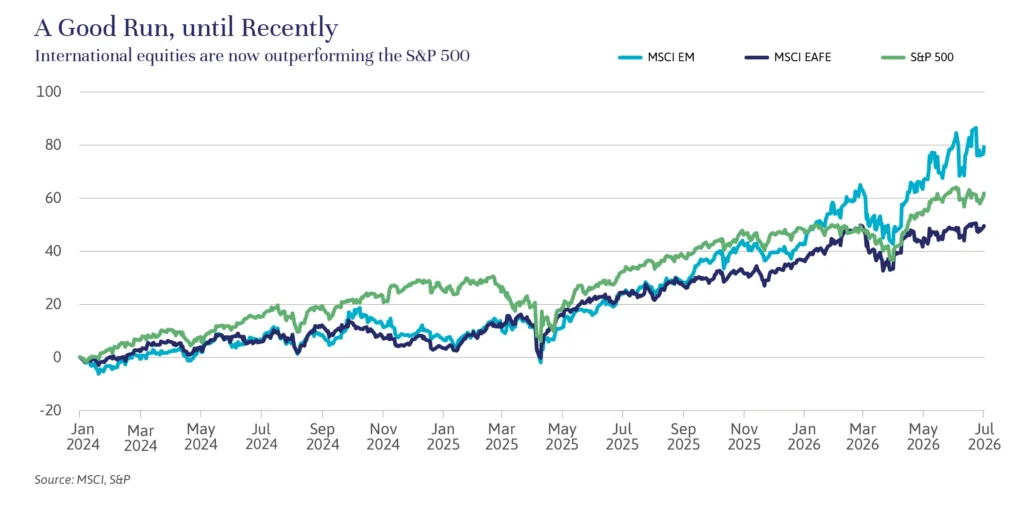
An allocation to the MSCI Global All-Country World Index 10 years ago would have been 53% invested in the United States. Today, that U.S. exposure would represent 63% of the investment. This imbalance reflects great returns – and great risk.1
Global diversification has always been a cornerstone of disciplined portfolio construction. True diversification means owning assets that do not all move together. Developed international markets, including Europe, Japan and the United Kingdom, as well as emerging markets such as Brazil, India and South Korea, have historically exhibited lower correlation to U.S. large-cap equities than many domestic alternatives. When concentrated risks in the U.S. market, whether driven by a handful of mega-cap technology stocks or domestic policy uncertainty, weigh on returns, international exposure can serve as a meaningful stabilizer. The valuation case is also compelling. International equities remain attractively priced relative to their U.S. counterparts. Emerging market equities, even after strong 2025 performance, trade at approximately 10.6 times forward earnings,2 a discount of just under 50% to U.S. valuations.
Developed international markets similarly trade well below long-term averages relative to the U.S. For valuation-conscious investors, that gap represents opportunity.
We remain mindful that clients should generally match their U.S. dollar assets to their U.S. dollar liabilities and carefully consider the tax consequences of diversifying appreciated positions. (Please see the recent article by Jon Kropf on balancing tax and diversification considerations, “Long-Term Gains: A Good Problem but a Problem Nonetheless”. Those considerations matter, particularly for taxable investors, but they should be weighed alongside the long-term benefits of reducing concentration risk and expanding exposure to the full global opportunity set.
Our international equity allocation is a commitment to the principle that a well-constructed portfolio reflects the full opportunity set of the global economy. The companies, economies and currencies of the world beyond our borders represent more than half of global economic output. While we remain broadly overweight the United States, we continue to rebalance portfolios, striving for an international allocation of at least 15% as appropriate.
Our approach to international investing has generally been to invest with active managers, although we are now pairing those managers with a low-cost, passive exposure to global markets excluding the United States. We also maintain direct exposure to Japan through a currency-hedged ETF that provides exposure to Japanese companies – particularly export-oriented businesses – while reducing the volatility of the yen.
Maintaining diversification discipline through shifting market cycles is, we believe, one of the most effective ways to protect and grow portfolios over the long term.
1 MSCI, “A Complete Geographic Breakdown of the MSCI ACWI IMI” 2MSCI, MSCI Emerging Markets IMI Indexes (USD), as of July 31, 2026.
This Independent Thinking® issue explores the challenges and opportunities of managing investment portfolios amid buoyant but increasingly volatile markets. It discusses the risks of market peaks, the potential for inflation