Sean is a Partner and Wealth & Fiduciary Advisor at Evercore Wealth Management and Evercore Trust Company, N.A. He advises families, foundations and endowments, delivering comprehensive planning solutions and fiduciary services.
Sean joined Evercore in 2024 from Clarfeld Citizens Private Wealth where he worked for 14 years as a senior advisor to ultra high net worth families, business owners, private equity principals, and senior corporate executives. He developed and executed creative investment, estate, tax, cash flow, and risk management strategies for his clients. He also contributed to the firm’s financial planning strategy and business development efforts throughout the Northeast.
Sean serves as a member of the board of directors and Treasurer for Legal Services of the Hudson Valley.
Sean earned a B.B.A degree in Finance and Economics from Queens College and an M.B.A. from the Zicklin School of Business at Baruch College. He also holds the CFP® certification.
For many entrepreneurs, their business represents a lifetime of effort. It’s been a source of pride, purpose and income. The idea of selling it and converting that value into a portfolio of diversified assets can feel unsettling, like moving from the known to the abstract and unpredictable. Thoughtful liquidity planning bridges that gap.
But first, what is the impetus for the sale? Is it a clean break, in preparation for the next stage of life? Is it investment for continued growth? Or is it the desired shift to an operational or advisory role, or a board position? For the founder, it is a very personal decision that will determine the best next course of action. A strategic acquirer may be willing to pay a premium. A financial sponsor may offer the opportunity to retain equity and participate in future growth.
Of course, the “number” may influence that decision. Experienced M&A advisors can evaluate the current market for the business. Wealth advisors, working alongside the M&A team, can further refine that choice, evaluating post-sale liquidity and preserving flexibility – so that the tax impact of a sale doesn’t reduce what initially appears to be a headline number to something materially different on a net basis.
Once a sale becomes a real possibility, attention turns to structuring, the phase in which the most meaningful wealth opportunities exist. The ownership structure going into a transaction can have a significant impact on what the owner keeps. The mix of cash at closing versus rollover equity, the presence of earnouts tied to future performance, and the degree of control retained post-transaction all play a role in shaping outcomes. So do transition periods – including non-compete agreements – and expenses that flow through the business.
Beyond those high-level considerations, there are more technical elements that can affect proceeds. Working capital adjustments, for example, can shift the amount received at closing, depending on how the business is normalized at the point of sale. Escrows and holdbacks may require a portion of proceeds to remain at risk for a period after closing. Indemnification provisions can create ongoing obligations tied to representations made during the transaction.
The distinction between an asset sale and an equity sale can lead to very different outcomes from a tax perspective, and these scenarios should be modeled in advance so that trade-offs are clearly understood. In certain cases, deferral strategies, such as installment sales, may also be appropriate, allowing taxes to be paid over time.
Collectively, these details can substantially change what the founder ultimately receives and when they receive it.
Who else should benefit from the sale? Employees and management teams are often critical to both the success of the sale and the continued performance of the company. Thoughtful planning around retention, incentives and participation can help ensure continuity and protect the value that has been created over time.
As for the founder, how much wealth should remain within the individual estate, and how much should be transferred to future generations? Transferring shares prior to a sale – often into trusts – can shift future appreciation out of the taxable estate while taking advantage of valuation discounts tied to lack of control or marketability. Timely execution can significantly reduce future estate and generation-skipping transfer, or GST, tax exposure.
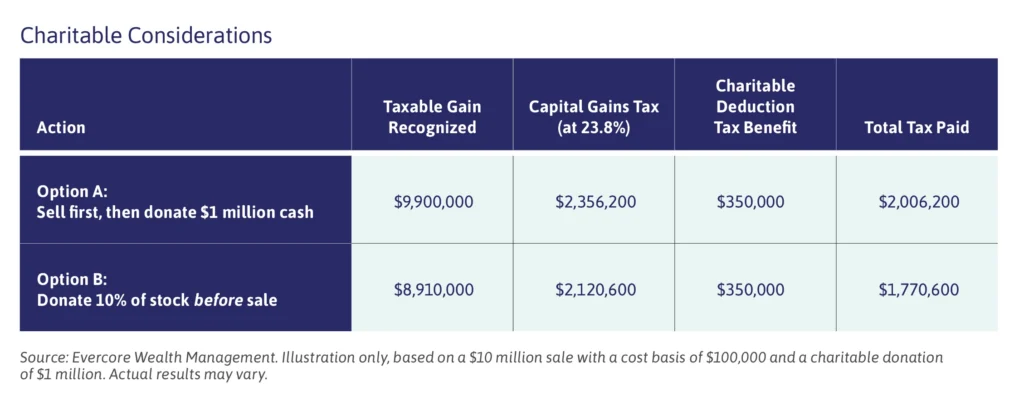
The period before a sale is a unique opportunity for philanthropically-minded founders. Donating appreciated shares prior to a transaction can eliminate capital gains tax on those shares entirely and qualify for a charitable income tax deduction, while still allowing the owner to direct proceeds to charitable causes. Vehicles such as Donor Advised Fund (DAF), or charitable trusts can help align giving with broader financial goals in a tax-efficient way.
Consider the founder who owns a private company with a cost basis of $100,000 and is preparing for an acquisition that values their total stake at $10 million. The founder wants to give $1 million of the proceeds to charity, which could offset over $200,000 in taxes. Let’s assume there are additional charitable gifts in the year of the sale to cover the 0.5% AGI floor for the charitable deduction and that there is at least $1,000,000 of ordinary income in the year of the sale to make the example cleaner. Simply changing the order of the gift in this example, as illustrated by the chart “Charitable Considerations,” can save $235,600 of federal taxes.
It is important to consider the anticipatory assignment-of-income doctrine before contributing private-company shares to a DAF, before a sale. The timing and status of the transaction at the time of the gift can affect whether the donor is treated as recognizing gain on the donated shares.
In certain cases, Qualified Small Business Stock planning can provide an additional layer of tax efficiency. Where applicable, it allows for the exclusion of substantial capital gains, often $10-$15 million per shareholder.
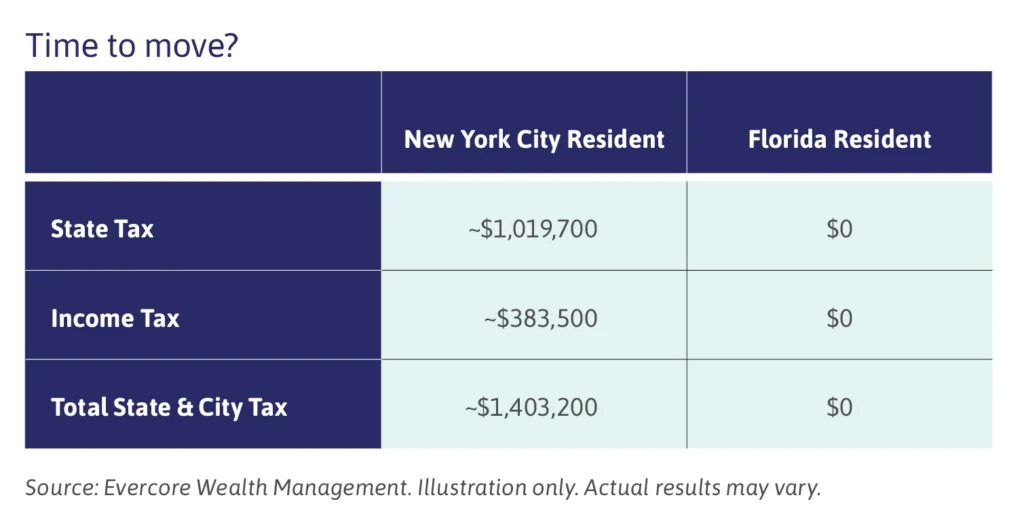
Another often overlooked, but highly impactful consideration, is state residency. Depending on where an owner lives, state-level taxes can reduce net proceeds. In some situations, a change in residency prior to a sale – when made thoughtfully and in compliance with applicable rules – can create substantial savings, as illustrated in the chart “Time to move?”. However, this type of planning requires time and careful coordination, with the right advisory team in place. Once a transaction is imminent, options become limited.
If the taxpayer is a New York City resident, New York State taxes the gain at 10.3%, and the city imposes its own resident income tax, topping out at 3.876%.
On the same basis, moving to Florida (where there is no state and no city income tax) before the $10 million stock sale could save the founder approximately $1.4 million in state and local income tax.
This works for the sale of privately held C-Corp stock or another intangible investment. The sale of an S corporation, partnership/LLC interest, New York real estate-heavy entity, or an asset sale can leave some or all of the gain taxable by New York even after moving.
The founder would also save their heirs a significant amount in transfer tax, as New York State has a top graduated estate tax rate of 16% on a taxable estate.
With all this considered well in advance, the owner can focus on the execution – and enjoying the next stage of life. A well-designed portfolio can replace the income the business once generated, while balancing growth, risk and stability. This includes recognizing that the nature of risk changes when moving from an operating business, where control is high, to financial markets, where outcomes are influenced by broader forces. The objective is not to chase returns, but to create a structure that provides clarity, flexibility and sustainability.
This Independent Thinking® issue explores the challenges and opportunities of managing investment portfolios amid buoyant but increasingly volatile markets. It discusses the risks of market peaks, the potential for inflation