Brian is a Partner and Portfolio Manager at Evercore Wealth Management, managing investments for families, foundations and endowments. He is the Chair of the Investment Policy Committee and co-Chair of the Asset Allocation Committee. He is co-head of the New York Office, Head of the Fixed Income Team and a member of the firm’s national Strategic Planning Committee. Brian additionally serves as Chief Investment Officer of Evercore Trust Company, N.A.
Brian joined Evercore in 2009 from AIG Investments where he co-managed over $60 billion in corporate bond portfolios. Brian earlier served as a corporate bond analyst, focused on basic industries, including paper/forest products, chemicals, and packaging companies. Prior to attending business school, Brian worked for the Milken Family Foundation.
Brian received his B.A. in History from the University of Pennsylvania and his M.B.A. in Finance from Columbia University. He holds the Chartered Financial Analyst designation and is a member of the CFA Institute.
Current Race: America Still Leads in AI, but China Leads in Power
The United States is still in pole position in the race to lead artificial intelligence, but weakness on the power front may cost it the advantage.
It’s been a great run. About three-quarters of global high-end AI compute capacity is U.S. based, and our head start in data centers, hyperscaler relationships, developer talent and capital continues to compound; San Francisco is the Renaissance Florence of our time; and there are pockets of excellence throughout the country. The United States is home to nine of the ten largest technology public companies in the world by market capitalization.1
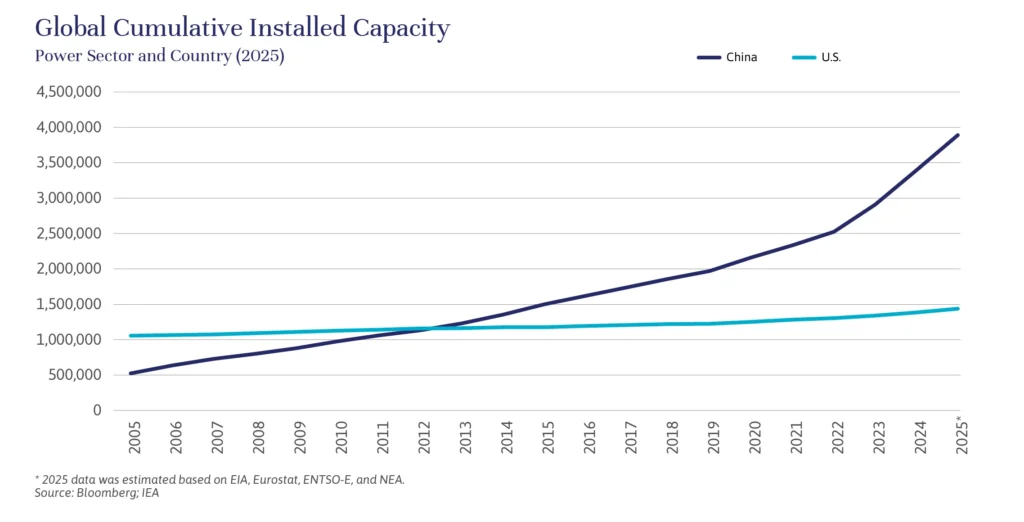
As AI permeates the fabric of daily life, rising demand is testing the limitations of the U.S. electricity grid systems, potentially constraining the buildout. Wait times for interconnection (the formal technical and regulatory integration) to the U.S. grid are now averaging as much as five years.2 And there is more backlash today at the state and local levels (see the article by Howard Cure, “Public Power: Data Centers”). In contrast, China has surplus electric capacity, by some estimates more than triple the U.S. supply. (For a deep dive into these national grid systems, please see the article “The Late Mover Advantage: A Brief History of the U.S. and Chinese Power Grids”.)
Grid capacity is built on physical components. These include solar panels, wind turbines, natural gas turbines, nuclear reactors, lithium-ion batteries, transformers, transmission cables, inverters and switches. China now leads manufacturing in most of these areas, as well as in rare earth mining and processing, thanks to significant cost advantages driven by meaningfully lower labor costs than in more developed economies, and manufacturing scale and automation that have led to greater efficiencies.
China has also become a massive net exporter of clean-energy technologies, even while allowing coal to still dominate actual domestic generation. At more than $165 billion, Chinese renewable exports now represent approximately 50% of the global total, excluding intra-EU trade.3
This renewable buildout, alongside significant reserves of imported oil and still plenty of coal, has helped China to largely shrug off the disruption to oil trade routes in the Middle East. As the world’s largest producer of natural gas, the United States is able to insulate its grid operators from energy shocks. But for the longer-duration buildout of storage, and nuclear and renewable power, the U.S. lags China by an increasingly wide margin.
Investing directly in China remains challenging, however. The country is the global leader in AI infrastructure buildout, but its public equity markets have not participated in its progress, as enthusiasm is tempered by the government restrictions on outsized returns. The MSCI China Index is down 6.3% annualized over five years through June 2026, compared with the 13.4% gain in the S&P 500 index over the same period. Our exposure to China is limited to mutual funds and ETFs that participate in the broader emerging markets.
To catch up to China, the United States will need to rely on its deep private capital markets, dynamic technology sector, and a track record of infrastructure mobilization when the economic stakes are high enough. (Please see a related Q&A with CIM, one of our external managers, ‘Beyond the Tax Benefits: A Q&A with CIM on “Opportunity Zones 2.0″‘.)
As fundamental investors, our job is to identify and invest in companies and sectors of the market that are reasonably priced and will likely participate significantly in the ongoing buildout of the U.S. grid. Businesses that had for many years been relatively boring to investors are more compelling now. These include power producers, utilities and infrastructure companies that are all critical to the AI rollout. Prices for some of these companies are running hot, but the growth opportunities have also materially changed, meaning that in some cases, the valuations and accompanying volatility may be justified. (See the article by Michael Kirkbride, “Powering U.S. AI Demand”.)
American ingenuity and capital will, we believe, eventually respond to the U.S. power constraint, but there’s no time to lose. Our hope is, of course, that the race metaphor itself becomes obsolete as the world’s major powers come to recognize that the stakes of artificial intelligence for humanity are too consequential for any single nation to navigate alone. As Thomas Edison supposedly put it: “Nothing is impossible. We merely don’t know how to do it yet.”
The Late Mover Advantage: A Brief History of the U.S. and Chinese Power Grids
Thomas Edison’s Pearl Street Station, a direct-current, coal-fired, 100-kilowatt power system in lower Manhattan lit 59 customers in 1882. From that modest beginning, thousands of isolated local systems spread across the country over the following decades, each built independently and each incompatible with the next.
Eventually, utility barons realized that scale was the key to making electricity affordable. Broad-based consolidation brought fragmented city systems into larger regional utilities in the early twentieth century, driving down costs and bringing power to millions of Americans.
The federal government filled the gaps, as the Rural Electrification Administration, launched in 1935, connected the farms and small towns that private capital had ignored, lifting rural electrification from roughly 10% at the time of passage to over 90% by 1950. Today, American homes, schools, hospitals and businesses are connected through a byzantine system that includes three major interconnections, 66 related balancing authorities, and a web of federal, state and regional regulators.
Remarkably, it works. The U.S. electricity grid (or, in effect, grids) has repeatedly absorbed transformative new loads while continuing to reflect a century of private interests and political compromise more than any engineering logic.
In contrast, China’s electricity story is one of the most compressed infrastructure transformations in history. When the People’s Republic was founded in 1949, the country inherited a devastated grid that provided less than 1/300 of the per-capita power generation available at the time in the United States. As late as Mao Zedong’s death in 1976, China’s grid was still uncompetitive with the West. But as Deng Xiaoping opened the power sector to private and foreign investment, Chinese GDP started to rise. The buildout that followed was unlike anything the western world has seen, thanks to a combination of state direction and private market capital, each deployed where it was most effective.
The Chinese government sets strategic direction, absorbs long-duration infrastructure risk and clears obstacles that no private investor could navigate alone. The best example of this was the forced relocation of over 1.2 million people to build the Three Gorges Dam, an undertaking that would have been legally and politically impossible in the United States or Europe. Ultra-high-voltage transmission, a technology the Chinese government nurtured and deployed at massive scale to carry power across half the country with limited transmission losses, was a tremendous feat of innovation.
At the same time, competitive private markets drove efficiency, eventually producing leading companies in solar manufacturing, batteries and power electronics that now supply not just China’s grid but also much of Asia, Latin America, Africa and Europe. China has reportedly reached over 3,800 gigawatts of installed capacity, more than triple that of the United States, having added in four years alone more generation capacity than the entire American grid had accumulated over a century, as illustrated by the chart, “Global Cumulative Installed Capacity”.
In short, China has built far ahead of current demand, providing a meaningful power capacity surplus, while the United States is at present operating at its effective power capacity ceiling.
1 Includes Nvidia, Apple, Alphabet (Google), Microsoft, Amazon, Broadcom, SpaceX, Meta and Tesla. TSMC is the lone non-U.S. company. 2 Lawrence Berkeley National Laboratory, “Queued Up: 2026 Edition,” June 2026. 3 IEA, Energy Technology Perspectives 2026.
This Independent Thinking® issue explores the challenges and opportunities of managing investment portfolios amid buoyant but increasingly volatile markets. It discusses the risks of market peaks, the potential for inflation