Stephanie is a Partner and Portfolio Manager at Evercore Wealth Management, managing investment assets for families, foundations and endowments.
Stephanie is the Chair of the firm’s External Manager Selection Committee, which is responsible for the selection, due diligence and ongoing monitoring of all third-party investment managers.
Stephanie joined Evercore in 2014 from Brandywine Group Advisors, a multifamily office, where she worked for eight years as an investment director, responsible for all aspects of the investment process. She previously worked at J.P. Morgan for seven years, focused on alternative asset management and private banking. She has significant experience in managing portfolios for high net worth individuals and families that invest in both alternative and traditional asset classes, including public equity, fixed income, hedge funds and private equity strategies.
Stephanie received her B.A. from the University of Colorado and her M.B.A. from Rice University’s Jones Graduate School of Business. Stephanie holds the Chartered Financial Analyst designation.
Beyond the Tax Benefits: A Q&A with CIM on “Opportunity Zones 2.0”
Editor’s note: Evercore Wealth Management supplements its core investment capabilities with carefully selected outside funds across the range of the firm’s asset classes, including illiquid alternative assets such as private equity and real estate, that have the potential for higher returns than the public markets. Here we interview CIM Group on real estate Opportunity Zones. Please note that the views of the external managers interviewed in Independent Thinking are their own and not necessarily those of Evercore Wealth Management.
Q: Evercore Wealth Management has allocated client funds to Opportunity Zones via CIM for some time. How does “Opportunity Zones 2.0” build on the original program?
A: The U.S. Opportunity Zones, or OZ, program was created in 2017 to spur private investment and create jobs in high-need U.S. communities by offering tax benefits to investors. Since its launch, the program has facilitated more than $100 billion in investment across real estate, infrastructure and operating businesses.1 OZ 2.0 represents the next evolution of the program, following the passage on July 4, 2025, of the One Big Beautiful Bill Act, which made the program permanent.
OZ 2.0 introduces several meaningful updates designed to better target investment toward truly underserved communities. Importantly, OZ 2.0 also introduces Rural Opportunity Zones, a new category intended to direct incremental capital into rural communities through enhanced tax incentives and a broadened investment scope beyond traditional real estate.
Investors can defer tax on a realized capital gain by investing all or a portion of the gain in a Qualified Opportunity Zone Fund, or QOF, generally within 180 days of realizing that gain. Only the capital gain, not the original cost basis, is eligible for reinvestment, allowing investors to reposition their basis elsewhere in their portfolio. These gains can come from a wide range of sources including, but not exclusive to, the sale of stocks, real estate or a business, providing flexibility to redeploy capital across asset types while accessing the benefits of the OZ 2.0 program.
Q: What are the key tax benefits now available to investors?
A: OZ 2.0 preserves and enhances the core value proposition of the program through three primary tax benefits available to investors allocating eligible gains into a QOF.
Tax Deferral: Investors can defer capital gains taxes when gains are invested into a QOF. Under OZ 2.0, these deferred gains remain untaxed for a five-year period following the investment.
Tax Reduction: After meeting the required five-year holding period, investors may receive a basis step-up on their investment. This step up reduces the amount of the original gain subject to taxation, enhancing after-tax returns. Traditional OZ investments receive a 10% step-up, while Rural OZ investments receive a 30% step-up.
Tax Exclusion: If an investor holds a QOF investment for at least 10 years, any appreciation generated can be realized tax-free upon exit, with the potential to extend this benefit for up to 30 years in an open-ended fund structure.
In addition to these primary benefits, there is a fourth, often underappreciated advantage:
Pass-through Depreciation Benefits: A QOF may be structured as a partnership, which allows investors to receive tax losses generated through tax depreciation deductions, without being subject to depreciation recapture if the QOF investment is held for at least 10 years.
This combination of timing benefits, basis reduction and tax-free appreciation can materially enhance after-tax returns, particularly when paired with strong underlying asset performance.
Q: How do Rural Opportunity Zones differ from traditional investments?
A: Qualified Rural Opportunity Funds are QOFs that hold at least 90% of their assets in “Rural Areas,” which are cities and towns with populations of no more than 50,000 people. Accordingly, Rural Opportunity Zone Funds introduce a differentiated investment focus within the framework, shifting away from the predominantly urban investment-driven strategy of OZ 1.0 toward a broader, rural-oriented opportunity set.
Historically, OZ capital has largely been deployed into urban multifamily and mixed-use developments. However, rural markets often lack the population density required to support these types of projects at scale. OZ 2.0 legislation incentivizes rural capital allocations with the potential for a 30% tax reduction instead of 10% for traditional OZ fund investments. Rural OZs are expected to attract increased investment in essential infrastructure to serve the economic needs in these regions.
Such infrastructure may include power generation, storage and grid-support assets; digital infrastructure, including data centers and connectivity; waste and water management systems; and transportation and logistics infrastructure. These asset classes are generally characterized by longer-duration cash flows, essential-use demand profiles, and in many cases, contractual revenue frameworks providing a distinct return and risk profile relative to traditional real estate investments.
Q: What are the most compelling investment opportunities within Opportunity Zones today?
A: A common misconception is that Opportunity Zones are primarily a tax-driven strategy. While the tax benefits are meaningful, we believe the attractiveness of OZ investments is ultimately driven by the underlying real asset opportunity and market cycle positioning. That’s true for both traditional and rural zones.
Within traditional OZs, several themes are shaping the opportunity set:
Real estate cycle recovery: Following a period of capital market dislocation and valuation repricing, real estate fundamentals are stabilizing, with improving entry points and forward return potential.
Pre-TCO capital solutions: Many OZ projects initiated in prior cycles are now approaching completion or stabilization (pre-temporary certificate of occupancy) but face capital structure challenges due to tighter lending conditions. This environment creates opportunities to provide strategic capital solutions across stressed capital stacks.
Defensive sectors: Multifamily continues to exhibit durable demand characteristics, supported by structural housing undersupply and demographic tailwinds.
Sports-anchored development: Real estate adjacent to major sports and entertainment districts can benefit from the structural demand created by franchise stability, with teams acting as long-term anchors that drive foot traffic, capital investment and tenant demand across surrounding residential, office and hospitality assets.
Rural OZ investments are expected to be driven by an infrastructure-forward investment thesis, supported by secular demand trends and structural underinvestment across critical infrastructure.
Key themes include:
Energy infrastructure: Rural markets often present attractive development opportunities due to land availability and proximity to transmission infrastructure. Assets may benefit from long-term offtake agreements, essential service demand and multi-decade operating lives.
Digital infrastructure: The continued growth in data consumption and connectivity needs supports demand for data centers, fiber and edge computing. Rural locations can offer scalability and power access for campus-style development, subject to infrastructure feasibility.
Waste and water management: These assets provide essential environmental and municipal services and may benefit from regulated or contract-supported revenue structures, long-duration demand and opportunities for operational modernization.
Transportation and logistics: Infrastructure supporting regional supply chains and distribution networks may benefit from strategic positioning along major corridors and essential-use characteristics.
Relative to traditional OZ strategies, Rural OZs can provide exposure to assets with longer-duration cash flows, essential infrastructure characteristics and differentiated macro drivers, including electrification, digitalization and supply chain reconfiguration.
Q: What are the key timing considerations for reinvesting gains into Opportunity Zone funds?
Investors must reinvest eligible gains within defined time frames, generally within 180 days of realization, but with gains generated by partnerships and S corporations that are reported on K-1s benefiting from extended timing that can span the full tax year, making both timing and fund structure critical considerations.
Q: How does vertical integration support successful OZ execution?
Execution is a critical determinant of success in Opportunity Zone investing, given the complexity of development, long hold periods, and the operational intensity required to achieve tax and return objectives.
A: We believe that a vertically integrated platform enhances execution in several key ways:
End-to-end asset management: Direct control over sourcing, development, construction and operations enables more efficient project execution and alignment across the investment life cycle.
Operational expertise: In-house capabilities across real estate and infrastructure allow for active asset management, cost control, and value-creation initiatives at the property and asset level.
Risk mitigation: Integrated platforms are better positioned to navigate entitlement, permitting, construction and operational risks, particularly in complex or infrastructure-heavy projects.
Capital structuring flexibility: The ability to address capital stack challenges, particularly in transitional or stressed projects, can be critical in capturing opportunistic entry points.
Long-term stewardship: OZ investments require a minimum 10-year hold to maximize tax benefits with up to 30 years of tax-free growth. A vertically integrated model and open-ended fund structure support sustained asset performance through market cycles.
Given the multidimensional nature of OZ investing, spanning tax structuring, real asset execution and long-duration ownership, platform capabilities are often as important as the underlying investment thesis.
Considerations on the road to OZ
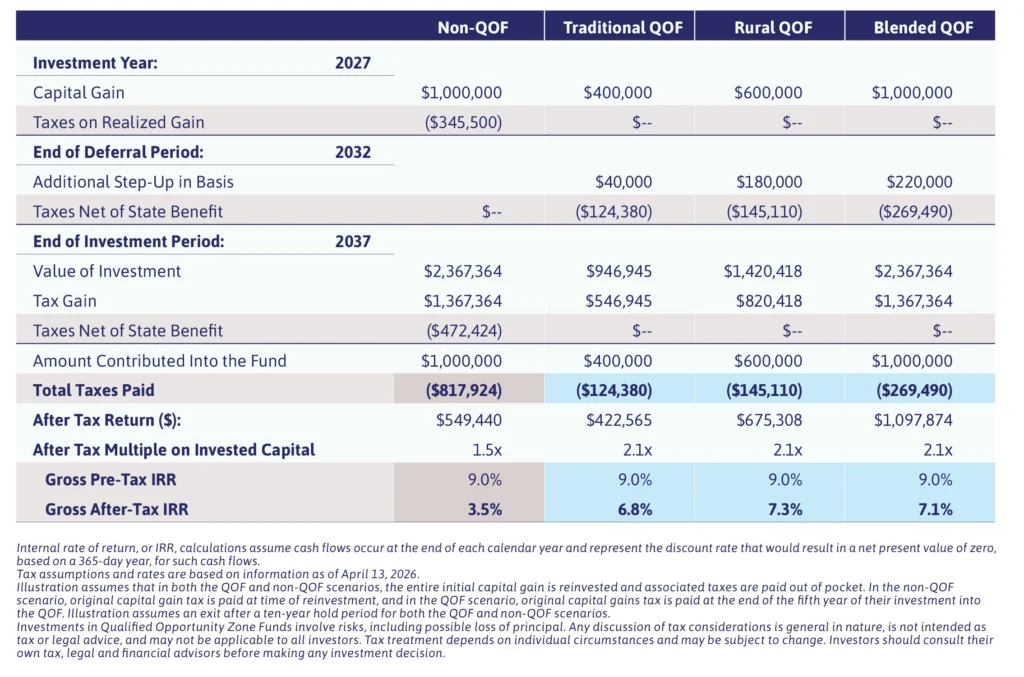
Opportunity Zone, or OZ, investing can provide compelling tax benefits, as illustrated by the chart on page 15. For a client with $1 million in capital gains and a long-term investment horizon, the chart shows that these tax advantages can make after-tax returns superior to similar investments that carry no tax benefit at all.
These benefits should enhance, not substitute for, sound investment underwriting. Investors still need to evaluate portfolio construction, long-term asset fundamentals, liquidity and, importantly, the manager’s ability to execute over a decade or longer.
That distinction is particularly important, given the themes discussed in this edition of Independent Thinking. Growing demand for power, grid capacity, and digital infrastructure are creating opportunities across many of the real assets now represented in the expanded OZ universe, alongside meaningful economic, regulatory and execution risks.
An OZ allocation should be sized and structured to fit the client’s broader asset allocation, goals and time horizon. Investors become eligible for tax benefits after a five-year hold, with the greatest benefit realized by holding for at least 10 years. Because these investments are illiquid, clients should confer with their Evercore Wealth Management advisory team to establish that an OZ commitment fits appropriately within their diversified portfolio.
In evaluating an OZ fund, there are several additional factors that we consider:
Manager capabilities. OZ projects frequently involve ground-up development or substantial redevelopment, followed by an extended operating and holding period. Investors should consider the team’s tenure and track record, and whether they have the resources and expertise to execute these projects and manage them effectively over time. It is also important to understand whether critical capabilities, such as development and property management, reside in-house or depend on third-party partners. Direct, in-house expertise can provide a manager with greater connectivity to the underlying assets throughout their life cycle.
Underlying investment quality. Investors should assess whether the fund manager is identifying attractive opportunities, whether investments are performing as anticipated, and whether the strategy makes economic sense independent of its tax advantages. Investment performance drives the potential value of tax-free appreciation.
A 10+ year investment horizon. The durability of long-term demand, the quality and competitiveness of the underlying assets, and eventual exit liquidity are important considerations. Strong secular demand does not eliminate project-level risks around permitting, power availability, construction timelines and changing market conditions.
Diversification. Investors should consider diversification across asset types (offices, infrastructure, residential and others), as well as geographies and stages of development. A diversified portfolio can reduce reliance on any single asset, market or point in the development cycle.
How OZ 2.0 may enhance after-tax returns
To highlight the practical impact of OZ 2.0, we compare four hypothetical investment scenarios: a non-OZ investment, a traditional QOF, a rural QOF and a blended QOF strategy. This comparison underscores how OZ 2.0’s enhanced incentives may drive incremental after-tax value.
Scenario assumptions:
9% annual growth rate
New Jersey income tax rate of 10.75%
Long-term capital gain tax rate of 20%
10% traditional/30% rural step-up in basis
Includes net investment income tax of 3.8%
The blended QOF reflects a 50/50 allocation split between a traditional QOF and a rural QOF
This Independent Thinking® issue explores the challenges and opportunities of managing investment portfolios amid buoyant but increasingly volatile markets. It discusses the risks of market peaks, the potential for inflation