Howard is a Partner and the Director of Municipal Bond Research for Evercore Wealth Management. He has over 30 years of experience in analyzing municipal securities.
Prior to joining Evercore in 2009, Howard was a director at the Public Finance Department of Financial Guaranty Insurance Company for 11 years. He previously was a vice president with the investment banking firm of Prager, Sealy & Co. and, earlier, a vice president at Moody’s Investors Service. He began his career as an economist with the New York State Senate Finance Committee in Albany, New York.
Howard is widely quoted in the media, including The Wall Street Journal, Bloomberg News/Business Week, Barron’s, Reuters, The Financial Times and The Bond Buyer, and he has appeared on CNBC, National Public Radio and Bloomberg News.
Howard received a Bachelor’s Degree in Economics from the State University of New York at Albany, and a joint Master’s Degree in Public Affairs from the Lyndon B. Johnson School of Public Affairs and an M.B.A. from the McCombs School of Business.
Love them or loathe them, data centers are core to AI expansion. Investors in U.S. municipal electric utilities need to evaluate the utilities’ relationships with local data center owners. Specifically, depending on the size of the data center load relative to available power supply, transmission access and capacity, and the utility’s existing customer base, the cost to serve data centers can be significant, presenting considerable challenges for public power.
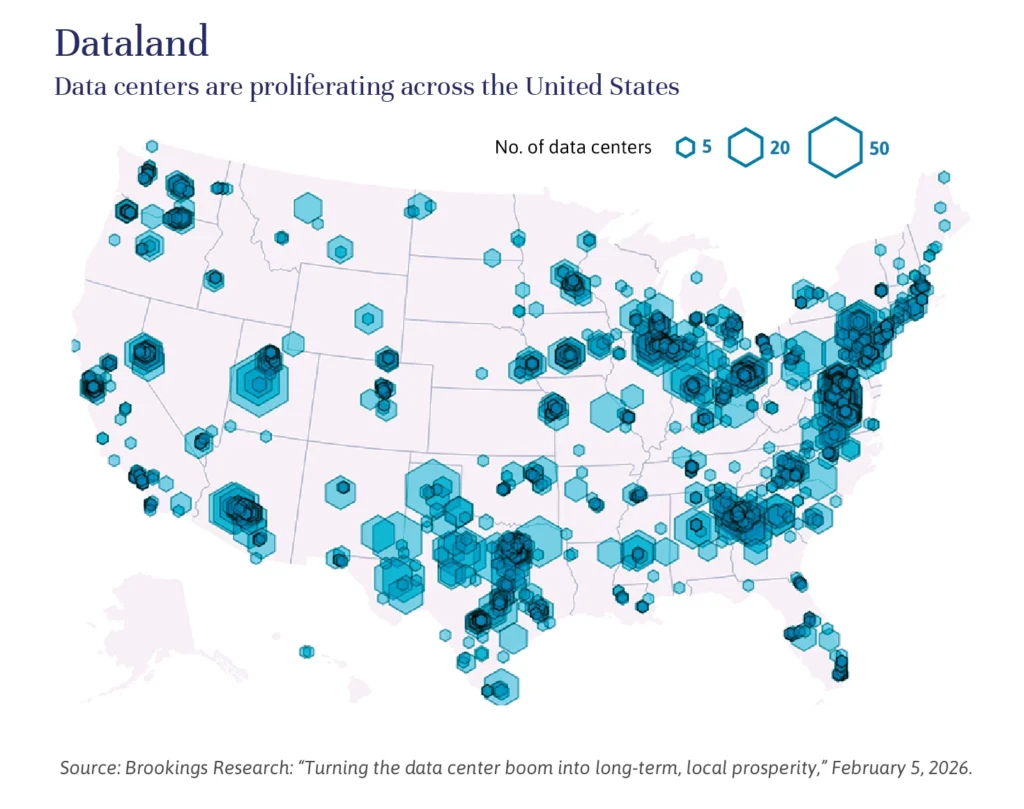
Investors also need to consider the potential for backlash. The boom of data centers, as illustrated here, is frequently cited as a prime reason for rising electricity prices, as their operation requires increased power generation and transmission, along with distribution upgrades. While other factors have also contributed to the rise in electricity prices over the past seven years, data centers are unquestionably a factor.1 As of June 2026, 15 states have considered or are considering a moratorium on data centers, meaning a temporary pause on their construction.2
There is also the question of economic growth potential for a region. Proponents of data centers argue that they create jobs and increase local tax bases. However, data center critics note that these employment opportunities are usually in the initial construction phase. In Virginia, which has the highest concentration of data centers in the United States, just one-third of the direct operational jobs created were permanent positions.3
Certainly, state legislators, governors and regulators are increasingly sensitive to voter concerns on potential community and ratepayer financial burdens. Virginia is imposing the first electricity consumption tax on data centers, regardless of whether the centers receive power from a utility or a self-supplied source. And Texas governor Greg Abbott has called for sweeping legislative action on data centers, to ensure that the centers don’t pass on their costs to residential electric customers, and that they manage water use and noise impact. New York now requires risk assessments, including environmental impacts, before breaking ground.
While access to power remains a key constraint for new data centers in most municipal markets, others find themselves with data center clusters, amplifying their impact. There are risks of overbuilding infrastructure and creating stranded costs if technological advancements improve data center energy efficiency or data centers opt to relocate.4 There could also be increased concentration of municipal utilities in industrial loads and revenue, reducing reliance on the generally more stable residential revenue base. Still, it is likely that new power generation assets, including natural gas-fired plants and renewable energy projects, will be constructed, notably near major sources of gas, like the Permian Basin in Texas, the Gulf Coast, and shale gas deposits in Pennsylvania and Ohio.5 While some of the largest data center markets in the U.S. are among the most water-stressed regions, including Texas, Arizona and California, water availability is likely to become a greater problem, discouraging all but the most efficient usage.
Water demand varies widely depending on the cooling system used by the data center. Evaporative cooling systems that use potable water introduce the most strain on a water utility. However, they can be deployed quickly, given the use of existing technologies, a key focus for data center developers striving for speed-to-market. Air-based cooling brings little direct water demand but does use more power.6 And the so-called behind-the-meter power generation sources near the data centers bypass the public grid to directly power facilities, helping organizations lower energy costs, avoid peak demand charges and improve resilience.
Well-run utilities should work with data center projects to supply their high demand for power while minimizing the impact on existing power customers. In evaluating the potential impact on data centers, investors need to assess the ability of the utilities to:
Establish long-term contractual agreements with data center owners, providing firm load commitments with upfront and ongoing capacity payments to minimize cost shifting to existing customers.
Include exit fees for committed data center loads to minimize the potential for stranded investment.
Consider joint construction of needed physical plants, along with other municipal, corporate and cooperative power providers, to spread the cost exposure.
Use or advocate for state or federal assistance via grants, loans and guarantees to support large, baseload generation investments, especially if the electricity is generated by nuclear power.
For well-run municipal electric utilities, data centers can represent a strong source of energy sales and revenue growth, and provide a considerable benefit to the local tax and economic base.
1The Lawrence Berkeley National Lab, “Factors Influencing Recent Trends in Retail Electricity Prices in the United States,” October 2025. These factors include distribution and transmission expenditures in part due to aging infrastructure and supply-chain constraints; natural disaster, extreme weather and wildfire mitigation imposing short- and longer-term costs, significantly increasing prices in some states; natural-gas price fluctuations due to international conflicts; and many state Renewables Portfolio Standard (RPS) programs. 2Brookings Institution article, “Data center moratoriums are not a substitute for oversight,” July 28, 2026. 3Rockefeller Institute of Government SUNY: “Clouds, Cables and Megawatts – States and Localities Grapple with the Data Center Boom,” May 2026. 4Stranded Costs: In traditional regulated energy markets, utility companies built expensive power plants or entered long-term fuel contracts with the guarantee that they would recover these costs through customer rates. The problem occurs when demand abates – in the case of Data Centers. The original utility is left with debt on outdated infrastructure with a diminished customer base. 5 Data Centers 2026 Outlook – Capacity growth remains robust as tenants prioritize speed to market – Moody’s Ratings, January 12, 2026. 6Moody’s Ratings: “Data centers heighten water management risks for local governments,” April 20, 2026.
This Independent Thinking® issue explores the challenges and opportunities of managing investment portfolios amid buoyant but increasingly volatile markets. It discusses the risks of market peaks, the potential for inflation