Michael is a Partner and Portfolio Manager at Evercore Wealth Management, managing investment assets for families, foundations and endowments.
Michael joined Evercore in 2019 from Fieldpoint Private, a boutique private bank headquartered in Greenwich, Connecticut, where he served for two years as a senior investment advisor, providing asset allocation, security selection, and estate and tax planning advice to high net worth clients. He previously worked for 13 years as a senior portfolio manager at U.S. Trust, managing $2 billion in assets for families and foundations.
Prior to joining U.S. Trust, Michael worked in education and policy as a charter member of Teach for America and as the manager of external relations at the Manhattan Institute.
Michael received a B.A. at Rutgers College and an M.B.A. from the New York University Stern School of Business. He serves on the board of LEEP Dual Language Charter School in Brooklyn.
A data center can be planned in weeks. A new large language model can reach millions of users in a matter of days. A hyperscaler, one of the massive cloud computing companies, can commit billions of dollars to chips overnight. But a utility can still take years to secure the supporting transformers, turbines, grid interconnection and local approvals.
AI is moving into normal corporate workflows: coding, customer service, advertising, recommendations, shopping, travel, gaming and enterprise automation. A large share of Airbnb’s engineering code is now co-authored with AI. Roblox is already running hundreds of AI models and processing more than a million AI inferences per second. Shopify, Uber, Expedia, Instacart and many other companies aren’t far behind. And it’s not just the technology sector. As expected, other companies are onboarding AI solutions as the market broadens.
The next phase is inference: the process of using models once they are already trained. Inference is persistent, user-driven, latency-sensitive – and unpredictable. A chatbot answers a prompt; an agent may plan, retrieve data, call tools, generate outputs, check its work and repeat the process. One user request can become the model for countless calls. As consumer and enterprise agents scale, token consumption – simplistically defined as the amount of text processed and generated by an AI system – can rise much faster than the number of visible user queries. Demand continues to increase but becomes harder to predict.
Jevons Paradox describes the rise in consumption when technological progress increases the efficiency with which a resource is used. In AI, better compute efficiency lowers the effective cost of intelligence, which encourages more queries, more tokens, more agents, more video generation, more real-time features and more embedded enterprise workflows. And the increasing demand for AI processing means an increasing demand for power and electricity. That, as Brian Pollak discusses in the article, “Current Race: America Still Leads in AI, but China Leads in Power”, is going to require a tremendous boost in electricity generation. In short, AI may be digital, but its next constraint is physical.
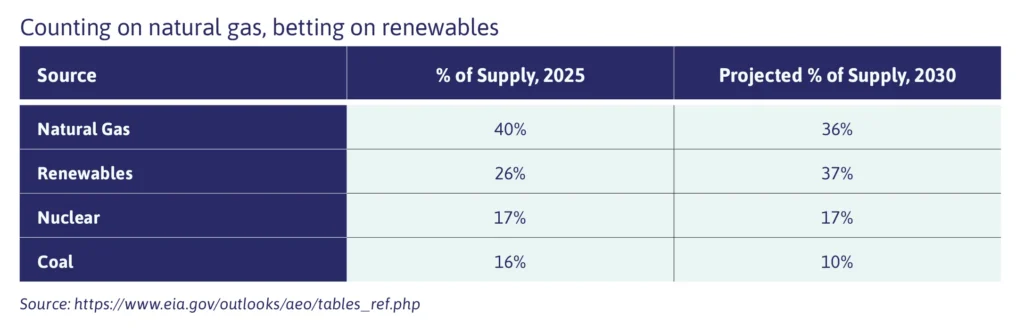
Investors should consider a range of potential energy sources, as it’s likely that the demand – along with the related reliability, cost, environmental and timing issues – will require a combination of solutions. (See chart “Counting on natural gas, betting on renewables”.)
Beneficiaries of this surging demand are likely to include electrical equipment companies, grid technology suppliers, transformer and switchgear manufacturers, cable makers, turbine suppliers, battery and storage companies, power semiconductor firms, cooling providers, engineering and construction firms, and utilities or independent power producers with scarce deliverable capacity.
At present, we are investing in Williams, which has a pipeline network that is core to natural gas infrastructure and is also increasingly contracting directly with hyperscalers; Generac, which produces large-scale generators that have become a data center niche; Amphenol, a manufacturer of wiring and connection systems; and Comfort Systems, installer of HVAC, mechanical, electrical and modular capabilities that are critical in building and cooling AI/data centers.
The winners in supporting AI demand will be the companies that can deliver firm, reliable and politically acceptable power quickly.
Age Matters
The International Energy Agency base case expects data-center electricity consumption to roughly double from about 485 terawatt-hours in 2025 to about 950 terawatt-hours by 2030. For context, one terawatt-hour is enough to power about 100,000 homes for a year. Powering AI will require everything we’ve got, for now. Longer term, some solutions are clearly more attractive to investors than others.
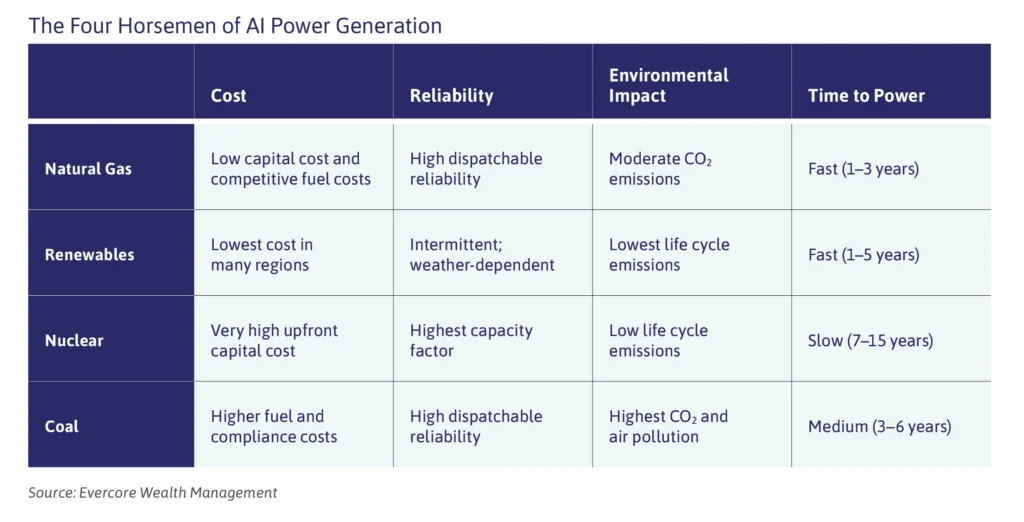
Natural gas is the near-term workhorse, currently supplying about 41% of U.S. utility-scale electricity generation. It is dispatchable, relatively scalable on a short timeline. But gas is not without complications. Turbines are backlogged; permits and pipelines take time; and local communities may oppose on-site generation. Gas helps solve reliability and timing, but it also introduces emissions, fuel-supply and permitting challenges.
Renewables are likely to carry a growing share of the load, rising to more than 35% in 2030 from 26% today. Solar and wind are inexpensive on a stand-alone basis and can be built faster than many conventional resources, while hydropower provides an important source of reliable, flexible, renewable generation where geography and water availability permit. But data centers need power around the clock, not just low-cost electrons when the sun shines or the wind blows, and hydro itself can be constrained by drought, seasonality and limited opportunities for new large-scale projects. That means a larger renewable system will still require storage, transmission, demand flexibility and reliable backup capacity. The relevant comparison is not simply solar versus gas; it is reliable clean power versus reliable fossil power.
Nuclear is strategically important but slower moving, representing just about 18% of generation today, compared with 68% in France, long a leader in nuclear power.1 Large reactors can provide clean baseload power, and small modular reactors remain a major topic of discussion. But at least through 2030, nuclear is more likely to be a long-term possibility than an immediate fix. Existing nuclear is highly valuable because it is clean, firm and always on, but new nuclear is unlikely to solve the near-term data-center power bottleneck at scale.
Coal remains part of the stack, but it is a declining and constrained option, representing about 17% of generation today and projected to be closer to 10% by 2030. Existing coal plants can provide dispatchable capacity and may run harder during periods of tight supply or high gas prices. But coal faces the highest emissions profile, aging-fleet issues, retirement pressure, financing constraints, and significant political and regulatory friction. It may help bridge some near-term reliability gaps, but it is not a likely growth platform for data center power.
Storage is the flexibility layer, not as a source of electricity production but as a key to reliability, and capacity is projected to grow roughly 15% per year through 2030. Batteries can help manage short spikes, smooth load, reduce grid stress and provide backup. They do not replace generation, but they make the system more responsive. As inference creates more volatile load patterns – sudden ramps, high-frequency noise and elevated baselines – storage becomes more valuable. But storage is still a complement to generation, not a substitute for firm power.
This Independent Thinking® issue explores the challenges and opportunities of managing investment portfolios amid buoyant but increasingly volatile markets. It discusses the risks of market peaks, the potential for inflation